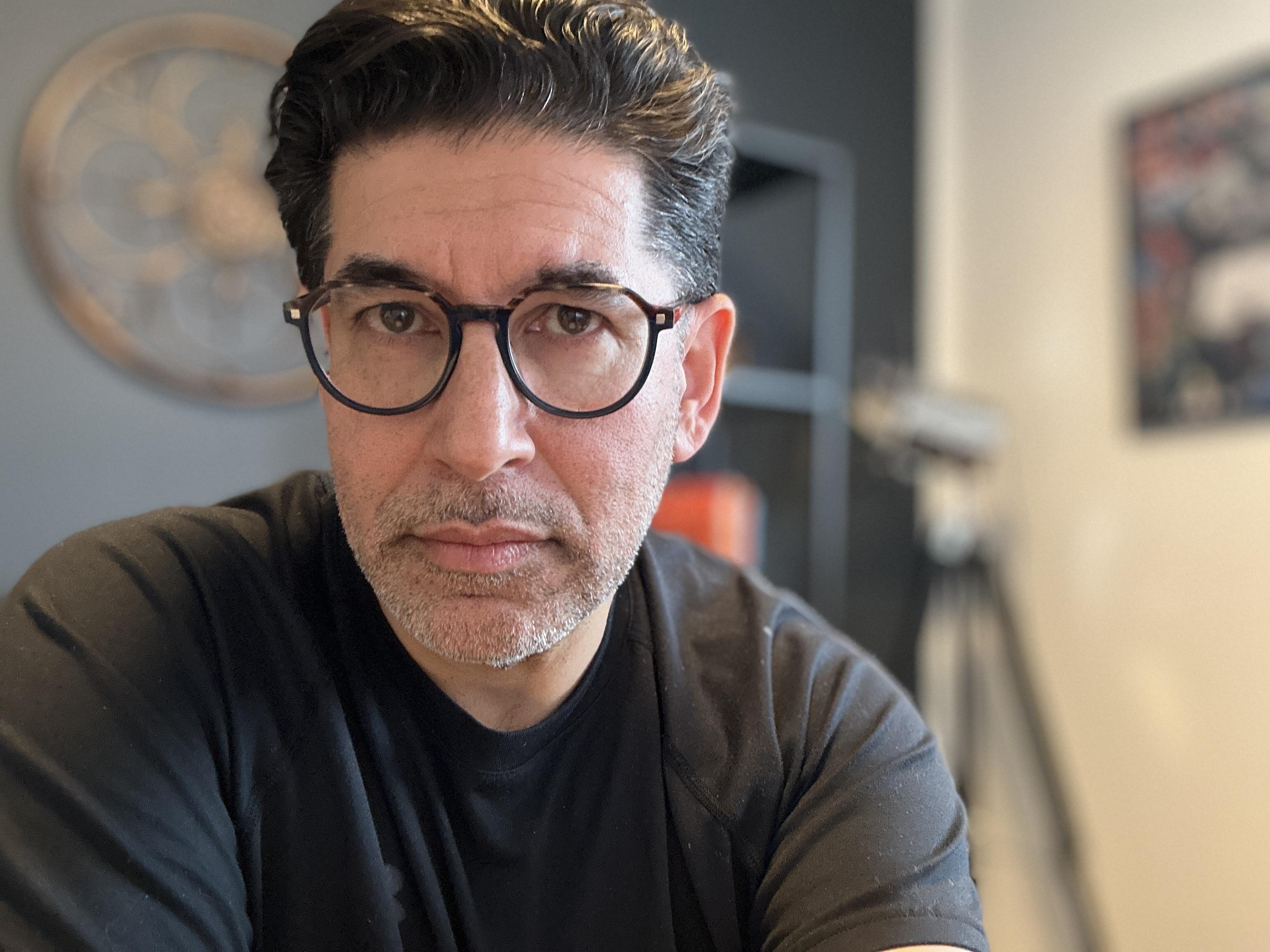
A Grieving Father's Love Should Not Require Him To Disappear. This Is My Personal Thesis.
Nothing prepares you for that kind of loss - the loss of a child.
You walk in as one version of yourself and you walk out as someone you do not yet recognize. That was me after losing Hashim on the 27th April 2005.
In the days that followed I went back to work. I ran my business. I supported my wife. I held it together for my other living children. I performed for decades while something underneath stayed completely still.
Nobody asked how I was or if I needed any help. The midwife who came to our home was kind and careful with my wife and never once enquired on how I was holding up. The people around me assumed that, because I was back and functioning as I use to.
My own business, with 250 employees and an HR department, had no framework for what to do when a man who has lost his child, let alone the person responsible for running the company.
My sales manager Tom was the only one person who stopped to ask. He looked me in the eye and for that moment we shared a moment of silence. One person in the whole building. And it was not even his job to do that.
I resigned myself quietly to the fact that nobody was coming to help and so I buried it. I got on with things because that is what I believed I was supposed to do.
Grief does not go away when you bury it. It waits. It resurfaces. And it still does on certain days and in certain moments. In the pause before I answer when someone asks how many kids I have. In those silent quiet moment alone, when the mask comes off, when I ask myself what could have been. In every April that arrives whether I am ready for it or not.
I spent years carrying it silently, pretending to be ok. And in all that time I never found a single space built specifically for a grieving father.
That absence is the reason I do what I do.
A few weeks ago I wrote an article on LinkedIn about the S.T.I.L.L Method and the day I became invisible. I want to go deeper here. Because understanding what I do requires understanding why I built it, what is actually broken and what the proof says so far.
What is the problem?
StillDad holds every kind of child loss. Miscarriage. Stillbirth. Neonatal loss. TFMR. The loss of a baby, a toddler, a teenager, a young adult or an adult child. There is no hierarchy here. A loss at eight weeks is not smaller than a loss at eight years. A loss that happened thirty years ago is not less worthy of space than one that happened last month. And there is no expiry date on grief - thinking that means you have left it too long to be heard.
If you are a father who has lost a child at any age, at any stage and at any point in your life, this community was built for you.
Child loss touches more families than most people realize. According to the Center for Disease Control and Prevention (CDC), hundreds of thousands of parents in the United States alone lose a child every year. Globally the numbers are in the millions annually. And that is across all types of loss, at every age, from miscarriage and stillbirth through to the death of a teenager or adult child. The scale is staggering. And behind every one of those losses is a father.
He goes back to work, usually within days. He supports his partner. He holds the family together. And when people ask how he is doing, he says 'fine' because the honest answer is way too heavy for a conversation that nobody around him is prepared for.
The medical system checks on the mother. The workplace measures him by his output. His friends do not know what to say and eventually stop trying.
Scientific evidence indicates that bereaved parents are more likely to suffer depressive symptoms, poorer wellbeing, less purpose in life, more health complications, marital disruption and even premature death and this applies to both mothers and fathers. And yet the support that exists is almost entirely oriented toward the mother.
And so he carries it alone. For months. Sometimes for years. And in some cases for decades.
This is not an individual failing. It is a systemic one.
Research from the University of Adelaide on men and grief found that fathers routinely push their own pain to one side. They decide their grief comes second before anyone else's. They even say it. They feel forced to choose every single day between being the supporter and being the griever. And they choose supporter because that is what they believe the world needs from them.
I recently sat with Mathew, a VP running eight construction locations across the country. He lost his daughter eighteen months ago. When I asked him whether he felt forced to choose between grieving and leading he paused. He had never thought about it in those terms. Then he confirmed it. His words were: "am I going to bury this and just be a robot for the next eight hours." And he said yes. That's what he did every single day.
That is what grief costs a father in facets of life. The brain fog. The motivation loss. The quiet disappearance of the man he used to be. Whether it's sitting in a hotel room alone at night while on the road or filling every empty hour with busyness - the painful alternative is facing the deafening silence with something that has no language, that has no voice.
A 2021 Sue Ryder report found that grief costs UK employers an estimated 23 billion pounds a year in lost productivity, absence and reduced performance. And from everything the research on male bereavement tells us, grieving fathers are among the least likely to be asked how they are holding up by anyone around them.
I know this firsthand. I was a business owner with 250 employees, my own company was not ready to receive me back. Nobody had a framework for what to do when the boss was the one who was grieving, let alone an employee.
The man who appears to have moved on has not moved on. He has just spent a very long time getting good at looking like he has.
What are dads trying that does not work?
Most dads who eventually seek help have tried a couple of things. They have read books. Some have started therapy. All of this is valuable and none of it is wrong. But for most grieving fathers something is still missing and they usually can't put a finger on it - they can't name it.
Mixed grief groups make them feel like a guest in a room that was never built for them. One to one therapy asks them to perform their emotions to a stranger before they even have the words for what they are feeling. Journaling on a blank page gives them nowhere to start because everything feels too big, too fuzzy and too shapeless to put down. And the suggestion to just talk about it runs headlong into decades of conditioning that says a man does not fall apart in public.
The result is a particular kind of stuck. They are doing something. They just cannot find the thing that actually reaches the part of them that is still carrying it.
What is needed is a third thing that compliments therapy and education. A structured private practice that gives the grief a shape, a language and somewhere for it to land safely. Where other dads around you understand without needing it to be explained or performed.
What is the solution?
What I'm referring to isn't a therapy programme. Or promising to fix grief because grief does not get fixed. What I'm eluding to, is that grief can be carried differently.
The answer to the problem I faced and what most grieving dads face today is what I'm dedicating my efforts to full-time - the building of the StillDad Community. A 12 month dad-focused online space built around the Letter Writing Journey Series, a structured five session writing programme that I now run for cohorts of grieving fathers.
The framework at the heart of everything I do is the S.T.I.L.L Method. I wrote about this in detail in a recent LinkedIn article and I want to summarize it here because it explains why what I have built works differently to anything else that exists for grieving fathers.

S is for Seen. Before anything else can move a father needs to feel genuinely seen. Seen as a man who loved his child. Seen as a father whose grief is real and whose loss counts. When a grieving father sits in a group of grieving dads, where every other person has also lost a child and the person leading the space has also lived it, something shifts. The barrier comes down. One of the dads in the Letter Writing Journey said it was the first time he had cried in a very long time. Simply because for the first time he was in a room where he felt safe to drop his guard without being judged.
T is for Tell. Grief that has no words has no place to land. Before a father can begin to move with his grief he has to name it. In his own words, in his own time, in his own order. Many of the fathers I have worked with have never spoken their story out loud properly, even years after the loss. They have spoken the short versions of it. The version designed to reassure the listener. The Tell principle asks them to put that version down and pick up the honest one.
I is for Investigate. This is not about letting it all out. It is about going looking for something. What I see in the sessions again and again is a dad searching. Searching for the words he has never been able to find. Searching for the meaning behind what happened. Searching for the things that have been sitting quietly at the back of his mind for months or years without ever being named. One dad told me that things came out in the writing that had never come out anywhere else., such as in therapy or in a simple conversation. It's because for the first time he had structure, privacy and a space that was built specifically for that kind of searching.
L is for Link. Most grieving fathers make a choice without even knowing they made it. They choose between being the supporter and being the griever. Between holding the family or the partner together and allowing themselves to feel something. Between leading a team or a business and looking after themselves. The Link principle is about connection. To himself. To his child. And to the men around him who understand without needing it explained. It is about realizing that the supporter and the griever were always the same man. That he does not have to choose between them. That he can hold both at the same time without letting either one go.
L is for Led. The final principle is the one that makes everything else possible. This work must be led by someone who has lived it. When a grieving father sits with another grieving father, one who has been where he is, who has carried what he is carrying, who can say I know because I have been there, the permission level changes entirely. The guard comes down faster. The honest version bubble up to the surface quicker.
Mathew said it himself in our conversation. He would not reach out because that is not in his nature. But if someone who had been through it came to him and named his exact experience, he would have listened. That is what led by a bereaved father means in practice.
What does this actually look like for a dad who joins?
The first five weeks are the Letter Writing Journey. Five sessions, each around 90 minutes, held online in a small group of five to seven dads. Each session is built around a set of guided writing prompts. You write privately first. Nobody sees what you have written unless you choose to share it. There is no ambiguity and no pressure to perform. The prompts do the heavy work of finding the words for you.
The structured sessions move through five letters:
What happened.
What you want for yourself.
Who you want beside you.
What comes next.
And finally a letter written directly to your child.
After those five weeks the community continues for the rest of the 12 months through four workshops that every dad moves through in his own time:
Before you go back to work: If you are approaching your first day back at work this session gives you a space to prepare for that threshold before you walk through the door. If you have already gone back, this session helps you finally make sense of what that experience cost you and what you have been carrying since.
The Weight of Guilt: For the dad who has been punishing himself. This session gives the guilt somewhere to land so it stops living in his chest and starts living on the page where he can look at it honestly.
Letters To The Living: For the dad whose relationships have quietly drifted since the loss. This session helps him find the words he has never been able to say to the people he loves most.
The Man I Am Now: For the dad who barely recognizes himself anymore. This session gives him space to look at who he has become since the loss and decide who he wants to be from here.

Every dad receives a recommended order at the start but chooses when he is ready for each one. Alongside the workshops there are two check-ins every month where a dad can show up, be heard and leave feeling a little less alone. A private online space sits open at all times so that when grief arrives at 11pm on a Tuesday night there is still somewhere to go. And when he needs something in his own time without having to show up for anyone that is available to him too.
At the end of the 12 months the same cohort of dads goes back through the Letter Writing Journey together. The same five letters. The same room. But a different man sitting in it. That second time through is where dads consistently describe the clearest sense of how far they have actually moved.
You do not need to be a writer. You do not need to be articulate about your grief. You do not need to be ready. You just need to show up.
Why should you trust me?
Because I have lived this for over two decades.
I lost Hashim in 2005. After burying him, I buried the grief under work and function and the role of the steady one. The provider. The man who held everything together. And underneath all of that something stayed completely still for a very long time.
Then the other losses came. My mother. My business, lost to a cyber attack in 2019. My marriage. The identity I had spent a lifetime building as a man, a father and a leader. And through all of it I was still carrying what I had never fully said out loud about my son.
That is not a credential I chose. It is the reason I am the right person to build this space for you.
When you walk through the door and say the honest version of your story for the first time, it is because you know I have been there. I have lived it. Carried it. And still carrying it.
I am a father. I am not a clinician and I have never claimed to be. What I am is a man who has been exactly where you are right now, who knows what the terrain looks like and who has spent years building the space he wished had existed when he needed it most.
You do not have to explain yourself here. I already know.
What does the proof say?
Cohorts of the Letter Writing Journey have now been independently assessed.
The pilot cohort returned a curriculum score of 90% and a Net Promoter Score (NPS) of plus 100 across all five sessions with zero detractors and every single dad giving consent for their testimonial to be used.
Subsequent cohorts returned a curriculum score of 89%, a Net Promoter Score (NPS) of plus 84, 100% programme completion across all dads and zero detractors across 32 individual responses.
An NPS of plus 84 sits in the exceptional range. 100% completion in a programme dealing with child loss is almost unheard of.
One dad said the writing had done more than six months of talk therapy. Another said it was the first time he had cried since his son died. A third said he now had a crew - Brothers In Loss (BIL) and was never completely alone anymore.
One dad, after completing the full five sessions, summarized the whole experience in three words. Courage, Hope, Brotherhood.
I have see dads arrive totally resigned. Some of them completely convinced that nothing could help them with what they're carrying. And then something shifts. Quietly. Without drama. The permissions change and whats under the surface, bubbles up.
What I am building and why it matters
The StillDad Community.

I am looking for fathers who want to be part of something that has never properly existed before. A private structured peer community built around a proven framework, led by a bereaved dad with years of lived experience, designed to give a grieving father somewhere to breathe, to think and to find some relief without asking him to move on.
Mathew put it better than I ever could when he told me what he actually needed. He said:
"... just get me to a place where I can think and breathe to get some relief."
That is the prize. That is what the StillDad Community is built to deliver.
This is not therapy. It is not a generic grief group. It is a dad-first space where you don't not have to explain yourself. Where your grief is taken seriously. Where you can carry your child forward without having to choose between being the griever and being the man your family still needs.
A father's love should not require him to disappear.
If you are a grieving dad or you know one - the link to the waitlist is below.
If you are a therapist, a grief practitioner, an HR professional or a business owner who wants to better support the grieving fathers in your community or your team, I would like to connect with you.
Learn more here 👉 https://tr.ee/VaZvK7
References
Sue Ryder - "Grief In The Workplace: How Employers Can Provide Better Bereavement Support", 2021. Research showing workplace grief costs the UK economy £23 billion per year in lost productivity, absence and reduced performance.
Centers for Disease Control and Prevention - National Center for Health Statistics. National Vital Statistics System. Annual child mortality data across all ages in the United States. Most recent data reports infant mortality at 20,050 deaths in 2024.
School of Psychology, University of Adelaide: Obst, K.L., Due, C., Oxlad, M. and Middleton, P. "Men's grief following pregnancy loss and neonatal loss: a systematic review and emerging theoretical model." Published in BMC Pregnancy and Childbirth, January 2020. The study found that fathers face double-disenfranchised grief, experience a lack of social recognition for their grief and are expected to support their partner while their own needs go unacknowledged.
⚠️ Please note: This research is specifically focused on fathers who have experienced pregnancy loss and neonatal death. While the findings on male grief, disenfranchisement and the lack of support for fathers are consistent with broader bereavement literature, the study sample does not cover child loss at all ages. StillDad supports fathers across all types and ages of child loss.
Evermore: Key Bereavement Facts. Research into the long term health, social and economic impact on bereaved parents including increased risk of depression, marital disruption and premature death.
World Health Organization: Child Mortality and Causes of Death. In 2024 an estimated 4.9 million children under the age of five died worldwide. Beyond early childhood a further 2.1 million children, adolescents and young people aged 5 to 24 also lost their lives that year.
StillDad Letter Writing Journey: Pilot Cohort Assessment Report, 2025/26. Independent curriculum assessment scoring 90%, Net Promoter Score plus 100, zero detractors, full testimonial consent. 👉 StillDad Letter Writing Journey Pilot Assessment Report
StillDad Letter Writing Journey: April 2026 Cohort Assessment Report. Curriculum score 89%, Net Promoter Score plus 84, 100% programme completion across seven dads, zero detractors across 32 individual responses. 👉 StillDad Letter Writing Journey April 26 Cohort Assessment Report


